Facebook
 X
X
 Pinterest
 Copy Link
By Lacie Pech, Realty with Lacie. Licensed Oregon real estate broker, born and raised in Central Oregon.
Every month a new set of Central Oregon market stats comes out, and every month somebody sends me a screenshot of one number with a worried text attached. Usually it’s the median sale price, and usually the number is missing all the context that would actually tell you what’s going on.
So here’s the honest version for the Bend and Redmond real estate market this summer. Not the scary headline, not the everything-is-amazing pitch. Just what the numbers say and what they mean if you’re the one buying or selling.
Quick note before the numbers: I’m a broker, not your lender or your accountant. This is the market, not advice about your specific situation. For that, let’s actually talk.
The short version
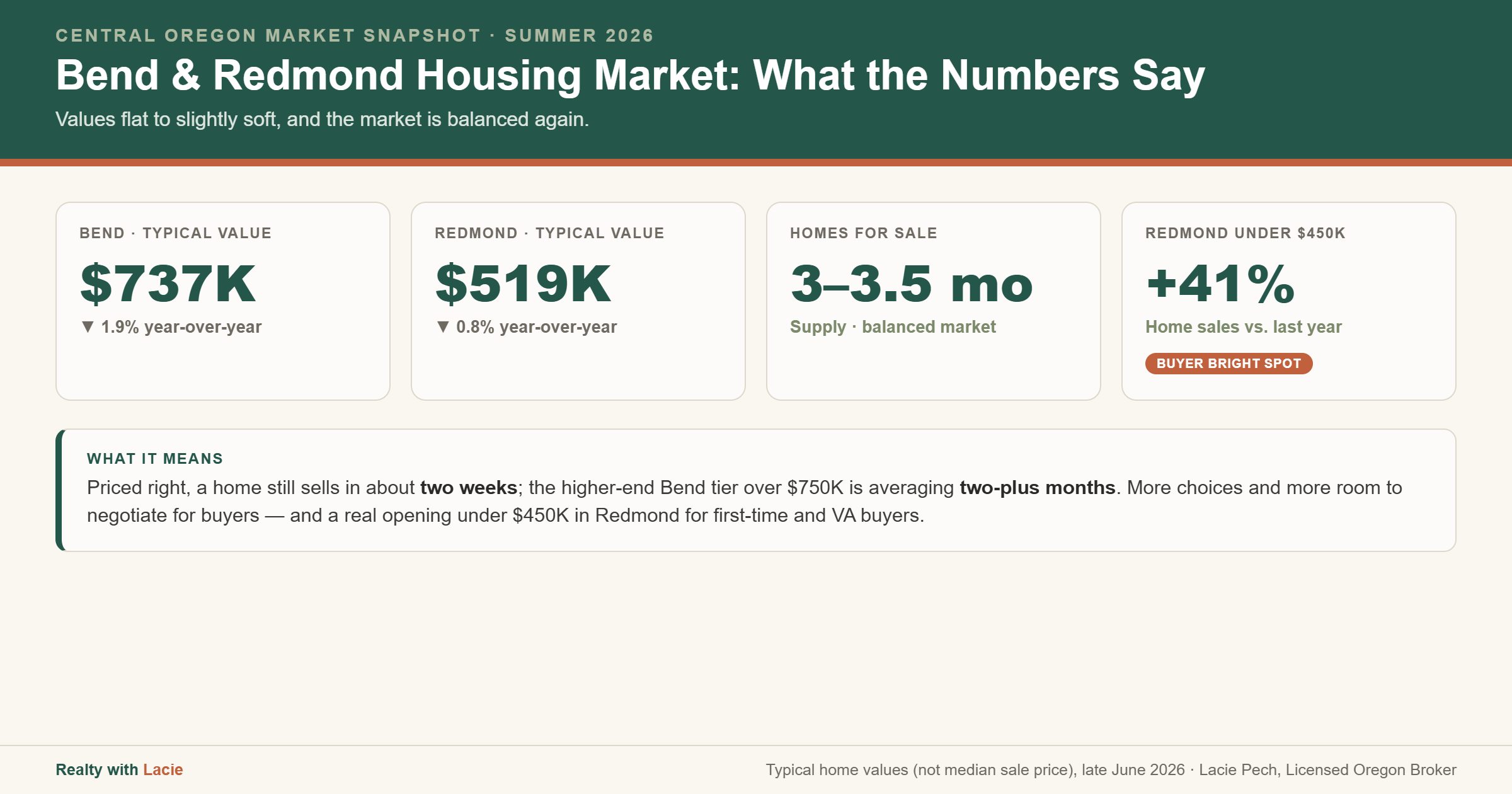
- Values are close to flat and a touch soft year over year. Bend’s typical home value was around $737,000 as of late June, down about 1.9%. Redmond was around $519,000, down about 0.8%.
- The market is more balanced than it’s been in years, sitting near a three to three-and-a-half month supply of homes.
- Speed is all about price. Priced right, a home still sells in a couple of weeks. Priced high, it sits.
- The bright spot for buyers is Redmond under $450,000, where sales were up about 41% over last year.
So did prices go up or down this summer?
Both, depending on which number you look at, and this is the part that trips people up.
There are two very different ways to measure a market. The first is the typical value of a home, which is basically an estimate across all the houses in town whether they sold or not. As of late June, that number sat around $737,000 in Bend and around $519,000 in Redmond, both down slightly from a year ago. That’s the flat, slightly soft story, and it’s the more stable one.
The second is the median sale price, which is only the homes that actually closed that month. That one bounces around a lot. If a bunch of higher-end Bend homes happen to close in May, the median jumps. If more starter homes close, it drops. It’s not that prices swung 15% in thirty days, it’s that a different set of houses sold. That’s the plumbing behind the number, and once you see it you stop panicking at every monthly report.
How fast are homes actually selling in Bend and Redmond?
Faster than the doom talk suggests, if they’re priced correctly. Well-priced Bend homes have been going to pending in roughly two to three weeks. Redmond runs a little longer, closer to three to four weeks on average.
But that average hides a split. A home priced where the market actually is can still sell in under two weeks with multiple people interested. A home priced on hope sits, and the higher-end tier over $750,000 has been averaging more like two-plus months. Same town, same week, totally different outcome, and the only variable that changed was the list price.
Both Bend and Redmond are sitting near a three to three-and-a-half month supply of homes. That’s a lot healthier than the one-month, everybody-fighting-over-everything market we had a few years ago. More choices for buyers, less automatic leverage for sellers.
What this means if you’re buying in Central Oregon
You have more room than buyers did in 2022, and I mean that literally. More homes to choose from, more time to make a decision, and more willingness from sellers to negotiate on price, repairs, or closing costs.
The standout right now is Redmond under $450,000. Sales in that range were up about 41% over last year, which tells me first-time and VA buyers are finding real options there. If that’s you, this is a market worth being in, not sitting out. Just know the top of the Bend market is a different animal, where cash made up roughly 41% of purchases, so competition still shows up on the higher-priced and turnkey homes.
My husband’s a contractor, so here’s the part I always add: the sticker price is only half the cost of a house. On the older stock, especially out toward La Pine and Prineville, budget for the well, the septic, the roof, and the heat source, not just the payment. I’d rather you know that going in than find it out after.
What this means if you’re selling
The market rewards accurate pricing right now and punishes optimistic pricing, quietly but expensively. In Redmond, sellers have been getting around 96% to 97% of their original list price so far this year, which means the overpriced ones are cutting later and netting less.
The pattern I keep seeing: a home that’s priced right sells in the first two or three weeks near ask. A home priced 5% high sits, goes stale, and eventually sells for less than it would have if it had launched at the right number. Buyers can tell when something’s been sitting, and a stale listing negotiates from weakness.
Erin and I list together, and pricing strategy is the first real conversation we have with every seller, before photos, before anything. Get that part right and the rest gets a lot easier.
The honest stuff about that median price headline
Here’s the thing nobody wants to say out loud. The single median number you see in a headline is close to useless for your house.
It lumps a downtown Bend home and a La Pine manufactured home and a Redmond starter into one figure, so it doesn’t describe your neighborhood, your price band, or your street. A median can rise in a month when your specific type of home actually softened, and vice versa. It’s a temperature for the whole region, not a diagnosis for your address.
If you want to know what’s happening to a home like yours, you need the comparable sales for your town, your price range, and your last ninety days. That’s a fifteen-minute conversation, and it’s a lot more useful than any one number in an article, including this one.
Central Oregon market FAQ
Are home prices in Bend, Oregon going down in 2026?
As of late June 2026, the typical Bend home value was about $737,000, down roughly 1.9% from a year earlier, and Redmond was about $519,000, down about 0.8%. So values are close to flat and slightly soft year over year, not crashing. The monthly median sale price moves around a lot more than that because it depends on which homes happened to close that month.
How long does it take to sell a house in Bend or Redmond right now?
It depends almost entirely on price. Well-priced homes in Bend have been going to pending in roughly two to three weeks, and Redmond a little longer. Homes priced above the market can sit for two months or more. Both markets are near a three to three-and-a-half month supply, which is close to balanced.
Is now a good time to buy a home in Central Oregon?
There’s more inventory and more room to negotiate than there was a couple of years ago, especially under $450,000 in Redmond, where sales in that range were up about 41% over last year. Whether it’s the right time for you depends on your own numbers, your timeline, and your loan, not on a market headline.
What does months of supply mean?
It’s how long it would take to sell every home currently for sale if no new ones came on, at the current pace of sales. Under about three months usually favors sellers, and five to six months is considered balanced. Bend and Redmond are near three to three-and-a-half months right now.
Are sellers still getting over asking price in Central Oregon?
Mostly not anymore. In Redmond, sellers have been receiving around 96% to 97% of their original list price so far in 2026. Priced right, a home can still sell fast and near ask. Priced high, it tends to sit and then sell for less after a reduction.
If you’re trying to figure out what this market means for your actual house or your actual budget, that’s the fun part for me. No pressure, just real info. Tell me your town and your price range and I’ll walk you through what’s really happening for homes like yours, including the honest stuff. 🏔️
I’ve got you.
Lacie
Market figures reflect the most recent Central Oregon data available as of early August 2026, from public sources including Zillow home value data (as of June 30, 2026) and reported Bend and Redmond closed-sale statistics for 2026. Real estate figures shift monthly and vary by neighborhood and price range. This article is general market information, not legal, lending, or tax advice.