Facebook
 X
X
 Pinterest
 Copy Link
This summer made the point for me. On the Fourth of July, the Coyner Fire started northwest of Redmond off Helmholtz Way and ran through juniper, grass, brush, and sage fast enough to put a Level 2 evacuation notice on nearby homes before it was stopped at about 20 acres.
Sisters had the bigger scare. The Akawa Butte Fire, started by lightning on July 16, grew to more than 27,000 acres northeast of town and pushed evacuations across the Sisters and Camp Sherman area, with a Red Cross shelter open at the high school before crews got it mostly contained in early August. Two very different fires, both close to home, and neither one was out in the middle of nowhere.
So let’s talk about defensible space, plainly. Not the scary version, the useful version. It’s the buffer you build around a house so a fire has a harder time reaching it. It’s also one of the few pieces of wildfire risk you actually control.
My husband’s a contractor, so I’ve spent a lot of years looking at how these houses are actually built and what a fire finds when it gets close. Here’s what’s worth knowing, whether you’re on acreage south of La Pine or a normal lot in a Redmond or Bend neighborhood.
The short version
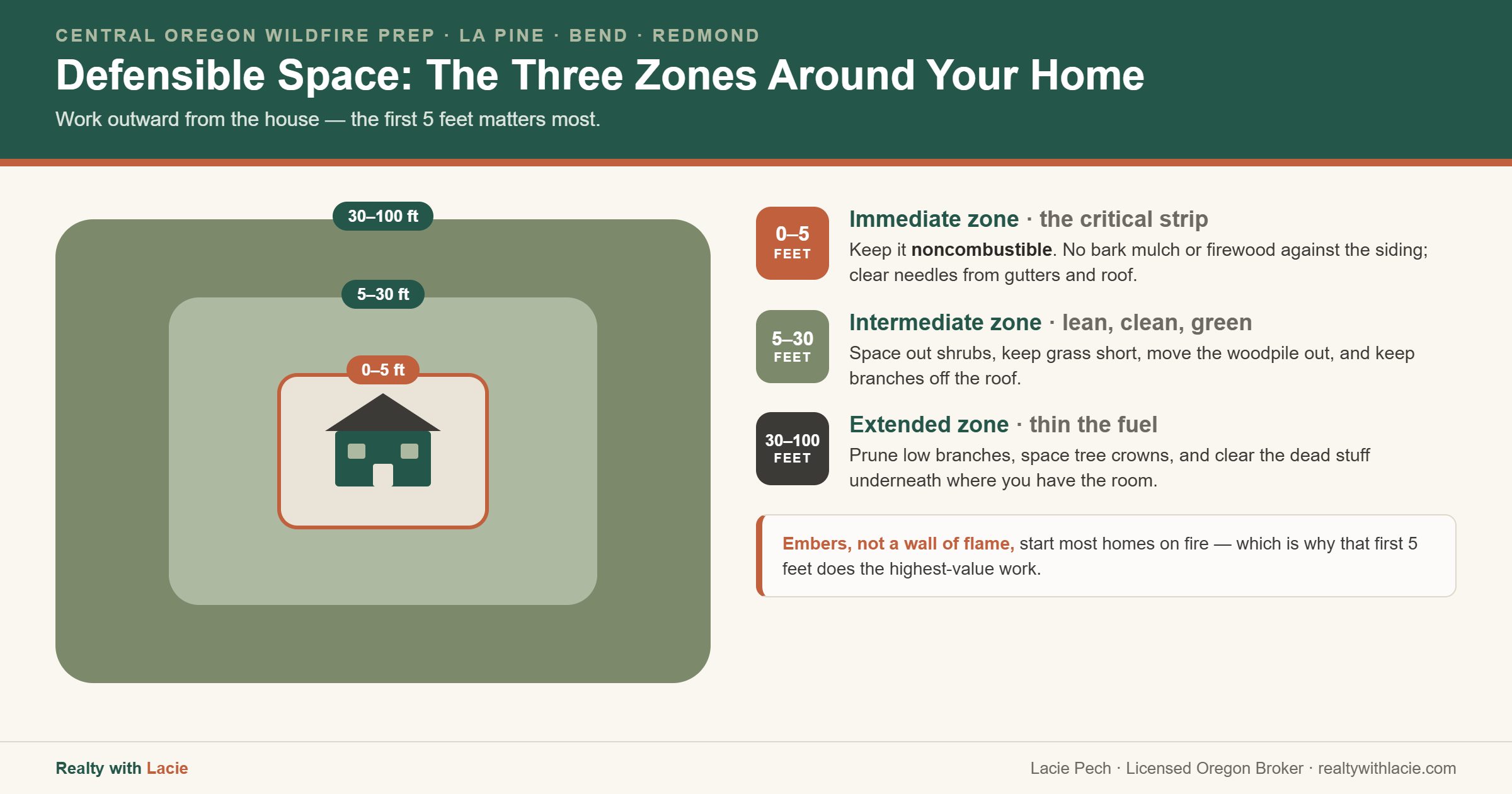
Defensible space is the cleared, hardened buffer around your home. It’s usually described in zones: the first 5 feet, out to about 30 feet, and out to roughly 100 feet where you have the room.
Houses in a wildfire usually catch from blowing embers landing in a weak spot, not a wall of flame. That’s why the first 5 feet and the roof and gutters matter more than people expect.
Oregon repealed its statewide wildfire map in 2025, so the old mandatory rules for existing homes are gone. Defensible space is still smart, still cheap to start, and still something insurers pay attention to. The first 5 feet is mostly free and it’s where I’d start.
What is defensible space, really?
It’s the space between your house and everything that can burn near it. The goal isn’t a moonscape. It’s to break up the fuel so a fire slows down, drops out of the treetops, and gives crews a place to actually defend the home.
Most guidance breaks it into three zones working outward from the house.
The first zone
0 to 5 feet
The strip right against the house. This is the most important and the most ignored. Keep it as noncombustible as you can: no bark mulch against the foundation, no firewood stacked on the siding, gutters and roof valleys clear of pine needles.
The middle zone
5 to 30 feet
Lean, clean, and green. Space out shrubs, keep the grass short and watered where you can, move the woodpile out here and away from the wall, and don’t let tree branches hang over the roof.
The outer zone
30 to 100 feet
Thin it out and break up the ladder. Prune low branches, leave space between tree crowns, and clear the dead stuff underneath. On a small lot you may not have this zone. On La Pine or Tumalo acreage, this is where a lot of the real work lives.
Does the La Pine, Bend, or Redmond part actually matter?
It does, because the fuel is different and so is the job.
La Pine and the deep-forest lots are mostly ponderosa and lodgepole, and the risk is standing trees, heavy needle cast, and a lot of ground fuel. Pine needles in the gutters and on the roof are a real problem here, and the outer thinning zone matters because there’s actual forest to thin.
Bend spreads across a wide range, from close-in lots to the west side and the neighborhoods that push right up against the trees. The homes backing to the forest edge carry more of the same work La Pine does, while a central Bend lot is mostly about the roof, the gutters, and the first 5 feet.
Sisters sits right up against the Cascade forest, so it carries the deep-timber version of this, closer to the La Pine job than the Redmond one. The Akawa Butte Fire this summer, out in the country northeast of town, was a reminder of how much fuel there is once you leave the city core.
Redmond is the one people underestimate, and this summer showed why. It’s juniper, sage, and grass more than deep timber, and that fuel dries out and moves fast in wind. The Coyner Fire ran through exactly that. You don’t need to be in the woods to have a defensible-space job.
What actually catches a house on fire?
This is the part my husband points out on almost every walkthrough. Most homes that burn in a wildfire don’t get taken by a wall of flame rolling over them. They catch from embers, sometimes blown in from well over a mile away, landing somewhere they can smolder and take hold.
So the house itself matters as much as the yard. The usual weak spots are the roof and gutters full of needles, vents that let embers into the attic or crawlspace, the first few feet around the foundation, and anything combustible tucked under a deck. Hardening those is often small, unglamorous stuff: cleaning the roof and gutters, screening or upgrading vents, keeping the 5-foot zone clean, and not storing the firewood and the plastic bins against the siding.
None of that requires tearing the house apart. A lot of it is a Saturday and a ladder.
Wait, didn’t Oregon get rid of the wildfire map?
Yes, and this trips people up, so here’s the honest version. In 2025 Oregon repealed its statewide wildfire hazard map through Senate Bill 83. That map had assigned properties to risk zones and carried mandatory defensible space and building standards, and it was unpopular enough that the Legislature undid it.
What that means in practice: the mandatory statewide requirements tied to that map for existing homes went away. Wildfire mitigation building standards now apply mainly to new construction, and the state is putting together a model code that local governments can choose to adopt. Your own city or county can still have rules, so it’s worth checking locally rather than assuming there are none.
Here’s the thing though. The map going away didn’t change how fire behaves, and it didn’t change what insurers care about. Defensible space is still recommended, and the state has specifically pointed to defensible space and home hardening as steps that can reduce risk. Gone is the mandate, not the reason.
What does this mean if you’re buying or selling here?
If you’re buying, especially in La Pine or on the forest edge, look at the defensible space and the roof and vents the same way you’d look at the furnace. Ask what’s been done. Factor in the work if it hasn’t. And start the home insurance conversation early, because in higher-risk areas getting a policy can take longer and cost more than buyers expect. That’s a question for your insurance agent, not a surprise for closing week.
If you’re selling, a clean 5-foot zone, clear gutters, and a tidy outer yard genuinely help. It reads as a cared-for home, and it’s one less thing a buyer’s inspector or insurer flags. Deschutes County’s FireFree program does free yard debris drop-off events, usually in spring, at sites around Bend, Redmond, Sisters, La Pine, and beyond. Dates move each year, so check firefree.org for the current schedule.
Defensible space isn’t a force field. In a bad wind-driven fire, embers travel and homes with good clearance still sometimes don’t make it. Anyone who promises you a guarantee is selling something.
But it meaningfully improves the odds, it gives firefighters a fighting chance to defend your place, and it’s the part of wildfire risk you can actually do something about. If all you ever do is the first 5 feet and the roof, you’ve done the highest-value work there is. Start there.
Central Oregon defensible space FAQ
What is defensible space?
It’s the buffer between your home and the grass, brush, and trees around it, built to slow a fire down and give crews a safer place to work. It’s usually described in zones: the first 5 feet, out to about 30 feet, and out to roughly 100 feet where the property allows.
How much defensible space do I need in Central Oregon?
The common guidance is to work outward in zones to about 100 feet where you have the room. The first 5 feet matters most. On a smaller Redmond or Bend lot you work with what you’ve got. On La Pine or Tumalo acreage, the outer zone is where much of the work is.
Is defensible space required by law in Oregon right now?
In 2025 Oregon repealed its statewide wildfire hazard map through Senate Bill 83, which removed the mandatory defensible space and home-hardening rules that had been tied to that map for existing homes. Mitigation building standards now apply mainly to new construction, and a model code is being developed for local governments to adopt if they choose. Local rules can still apply, so check with your city or county. Even without a statewide mandate, defensible space is still strongly recommended.
Does defensible space affect home insurance?
It can. Insurers weigh wildfire risk when they decide whether to write a policy and what to charge, and defensible space and home hardening are among the steps the state has pointed to for reducing risk. It’s not a guaranteed discount. For your specific situation, talk to your insurance agent, since that’s their lane and not mine.
What’s the cheapest first step?
The first 5 feet, and it’s mostly free. Move firewood off the siding, clear pine needles from gutters and the roof, pull bark mulch back from the foundation, and trim branches touching the house. No contractor required, and it targets exactly where blowing embers tend to start a fire.
Where can I dump yard debris for free in Deschutes County?
Deschutes County’s FireFree program runs free yard debris drop-off events, usually in the spring, at sites including Bend, Redmond, Sisters, La Pine, Sunriver, and Madras. Dates change each year, so check firefree.org or the Deschutes County site for the current schedule.
If you’re looking at a place in La Pine, Bend, or Redmond and you’re not sure how big the defensible-space job really is, I’m glad to walk it with you. Between thirty years here and a contractor in the family, we can usually tell pretty quickly what’s a Saturday and what’s a real project. No pressure, just an honest read. 🌲