Neighborhoods & Community September 8, 2026

Fall in Central Oregon: Pumpkin Patches, Festivals, and Golden Larches Worth Planning Around

By Lacie Pech, Realty with Lacie. Licensed Oregon real estate broker, born and raised in Central Oregon.

Summer here gets all the attention. The float, the lakes, the patio season. But if you ask people who actually live in Bend which season they would keep if they only got one, a lot of us are going to say fall.

The air changes in the second week of September. The visitor traffic thins out. You can get a table. And for about six weeks, Central Oregon does this thing where the weather is perfect, the light goes gold in the afternoon, and every small town within forty minutes throws some kind of festival.

Here is what is actually worth putting on the calendar this year, with the real dates, plus the stuff nobody warns you about.

The short version

  • Sept 26: both Terrebonne pumpkin patches open the same day, DD Ranch and Smith Rock Ranch
  • Oct 2 to 4: Bend Fall Festival takes over downtown Bend
  • Oct 10 and 11: Sisters Harvest Faire on Main Avenue, free to walk in
  • Early to mid October: the golden larches, which last a few weeks at most
  • Go to the patches on a weekday if you can, and go in the first two weeks

Both pumpkin patches are in Terrebonne, and they open the same day

This surprises people who are new here. The two big Central Oregon pumpkin patches are not in Bend or Redmond. They are both out in Terrebonne, about twenty five minutes north of Bend, and in 2026 they both open Saturday, September 26.

DD Ranch

3836 NE Smith Rock Way, Terrebonne. Open September 26 through October 31, Tuesday through Sunday, 10 a.m. to 5 p.m. Closed Mondays. No entry fee and no parking fee.

DD Ranch is the one I send people to first, mostly because of how they price it. There is no admission at all. Activities run on tickets at $3.75 each, so you buy what your kids actually want to do instead of paying forty dollars at the gate for a family that is going to last ninety minutes.

They have pony rides, a train, a hay maze, hayrides, jumping pads, pedal go carts, and a petting zoo. Vendors and food trucks show up on weekends.

One thing worth knowing: starting the week of October 6, weekday activities get thinner because school field trips take over. If you are going on a Tuesday in mid October expecting the full setup, check their social first.

Smith Rock Ranch

Terrebonne. Opens September 26, 2026, Tuesday through Sunday, closed Mondays. Closes for the season at 4 p.m. on Halloween.

Smith Rock Ranch is the corn maze one. They cut a new themed design every year, and they do a u pick pumpkin patch and pumpkin cannons, which are exactly as loud as they sound. Check their hours and pricing page before you go, because the ticket structure is different from DD Ranch.

Honest advice on both: go early in the season and go on a weekday if your schedule allows it. The last two weekends before Halloween out there are a different experience, and not a better one.

Bend Fall Festival, October 2 through 4

Downtown Bend. Friday, October 2, 5 to 10 p.m., music and food only. Saturday, October 3, 11 a.m. to 10 p.m. Sunday, October 4, 11 a.m. to 5 p.m.

This is the big one, and it closes down a chunk of downtown Bend for a weekend. Artist booths, live music, food, the whole thing.

The Friday night piece is easy to miss because it is music and food only, no vendor booths, which honestly makes it the better night if you do not love crowds. Saturday is the full experience and it is busy. Sunday afternoon winds down earlier and is the gentlest option with little kids.

Park once and walk. Trying to move your car downtown that weekend is a bad plan.

Sisters Harvest Faire is the second weekend of October, every year

Main Avenue, downtown Sisters. October 10 and 11, 2026. Free admission.

The Sisters Harvest Faire is always the second weekend in October, which makes it one of the easier things to plan around. It runs down Main Avenue with artisan vendors, live music, and seasonal food, and it is free to walk in.

Sisters in October is worth the drive on its own. It is a twenty two mile shot west from Redmond, and the last stretch in has the mountains sitting right in front of you.

The golden larches are the thing nobody tells you about

If you are new here, this one is going to surprise you. Western larches are conifers that lose their needles, and for a couple of weeks in October the whole tree turns gold while everything around it stays green. It looks like a mistake. It is spectacular.

Three places to find them without a serious expedition:

Shevlin Park, inside Bend city limits. The Shevlin Loop Trail runs along Tumalo Creek and there is a Western Larch Trail out there. This is the one you can do on a random Tuesday afternoon.

The Metolius Preserve, south of Camp Sherman. A two to three mile hike from the North Trailhead gets you into a larch grove. Make a day of it, Camp Sherman is worth the stop.

The Ochoco National Forest, east of Prineville. Canyon Creek Road is a drive rather than a hike, and the Steins Pillar trail is out that way too. This is the option if you want to actually get away from people.

Timing matters here more than anywhere else on this list. Peak is early to mid October and the gold holds for a few weeks at most. If you wait for a free weekend, you will miss it.

The honest stuff

Fall here is not uniformly gorgeous, and I would rather tell you that now than have you feel lied to in three weeks.

Smoke can hang around into September. Most years it is done by mid month, but not every year, and there is no way to know in advance. Every local has an air quality app and checks it before committing to an outdoor plan.

The weather turns fast. We can go from a seventy degree afternoon to snow on the passes inside of a week. If you are driving to Sisters or out to the Ochocos in late October, look at the forecast that morning, not three days out.

And the pumpkin patch weekends get genuinely crowded. Both Terrebonne patches are on two lane roads. The last Saturday before Halloween, you are going to sit in a line of cars on Smith Rock Way. Nobody tells you that part.

If you happen to be house hunting this fall

Quick note, since this is what I do.

Fall is one of my favorite times to have buyers out, and not for a sentimental reason. There is less competition than in June, and the sellers who are still on the market in October are usually the ones who need to sell. That is a different negotiation than you get in the spring.

The bigger reason is that you finally get to see a house in weather that tells you the truth. My husband is a contractor, so this is the lens I have been trained into. In September everything looks fine. In October and November you find out where the water actually goes when it comes off the roof, whether the driveway drains or holds a puddle, how the house holds heat in the evening, and whether that wood stove is a charming feature or a real heat source you are going to depend on in January.

In La Pine and out toward Prineville, where a lot of homes are on well and septic, fall is also when you start seeing how a property handles moisture. Summer hides all of that.

You are not going to catch any of it walking through on a seventy five degree afternoon in July.

If you want the data side of that rather than my opinion, I broke down what the 2026 numbers actually say about buying in Bend in the fall in a separate post.

Common questions about fall in Central Oregon

When do Central Oregon pumpkin patches open in 2026?

Both of the big Terrebonne patches, DD Ranch and Smith Rock Ranch, open Saturday, September 26, 2026. DD Ranch runs through October 31 and Smith Rock Ranch closes at 4 p.m. on Halloween. Both are open Tuesday through Sunday and closed Mondays.

When is the Bend Fall Festival in 2026?

Friday, October 2 through Sunday, October 4, in downtown Bend. Friday runs 5 to 10 p.m. and is music and food only. Saturday is 11 a.m. to 10 p.m. and Sunday is 11 a.m. to 5 p.m.

When is the Sisters Harvest Faire?

Always the second weekend in October. In 2026 that is October 10 and 11, along Main Avenue in downtown Sisters. Admission is free.

Where can you see fall colors and golden larches near Bend?

Shevlin Park inside Bend city limits has a Western Larch Trail along Tumalo Creek. The Metolius Preserve south of Camp Sherman has a larch grove about two to three miles in from the North Trailhead. The Ochoco National Forest east of Prineville has larches along Canyon Creek Road and near Steins Pillar. They turn gold in early to mid October and hold the color a few weeks at most.

Do the Terrebonne pumpkin patches cost money to get in?

DD Ranch has no entry fee and no parking fee. Activities run on a ticket system at $3.75 per ticket, so you pay for what your kids actually do. Smith Rock Ranch posts its pricing on their hours and pricing page, so check that before you go.

Is fall a good time to buy a house in Central Oregon?

Often, yes. There is less buyer competition than in summer, and sellers still on the market in October tend to be more motivated. You also get to see a house in real weather, which tells you how it heats, how it drains, and what you are actually signing up for. That is hard to evaluate in July.

If you are reading this from somewhere else and trying to figure out whether Central Oregon is a place you could actually live, fall is the season I would tell you to visit in. Not summer. Summer is the version we show people. October is the version we keep.

And if you are catching this on the wrong side of the calendar, here is the summer companion piece: things to do in Central Oregon before school starts.

And if you are already here and thinking about a move, whether that is this fall or next spring, I am always happy to just talk it through. No pressure, just real info, including the honest stuff. 🍂

Neighborhoods & Community August 27, 2026

Know Your Farmer, Know Your Food: A Local’s Guide to Central Oregon Farms, Ranches, and Markets

By Lacie Pech, Realty with Lacie. Licensed Oregon real estate broker, born and raised in Central Oregon.

Part of my childhood was spent on a farm. Milk cows, meat cows, goats, chickens, ducks, and a garden that was not optional. I was moving irrigation lines and cutting hay before I could legally drive, although I did drive to plow.

So knowing who grows my food is not a trend thing for me. It is just how I grew up, and it is one of the parts of living here I have never wanted to give up.

Here is my honest list of the Central Oregon farms, ranches, and markets worth knowing, where I actually shop when the outdoor markets close, and what fall is really the season for. At the end I put the thing people ask me most as a broker, which is what to check before you buy a place with a little land and a big idea.

The short version

  • Wednesdays are the Bend Farmers Market in Brooks Alley, 11am to 3pm, running through October 14 this year.
  • Year round, Central Oregon Locavore at 1841 NE 3rd St in Bend is open seven days a week, 10am to 7pm, and Agricultural Connections delivers.
  • Worth the drive: Rainshadow Organics between Sisters and Terrebonne, Root Down Acres on Erickson Road in Bend, and DD Ranch on Smith Rock Way in Terrebonne.
  • Fall is the real season. Winter CSA shares, beef shares, and the November bulk buying market are how locals eat well in February.
  • Thinking about acreage? Irrigation water rights do not automatically come with the land. Confirm the right, the district, and the acreage before you write an offer.

Where I actually shop when the outdoor markets are closed

This is the part most guides skip. Anyone can tell you to go to a farmers market in July. The trick is eating local in January.

Central Oregon Locavore

1841 NE 3rd St, Bend. Open seven days a week, 10am to 7pm, year round.

An indoor, nonprofit local food market. Produce, meat, eggs, cheese, and pantry goods, mostly from farms within a short drive of here. About 65 cents of every dollar you spend goes back to the producer, which is a very different split than a grocery store. They are also working on a westside location.

Agricultural Connections

Online ordering, roughly Thursday morning through Sunday night. Pickup and delivery in Bend, Redmond, Sisters, and Sunriver.

Think of it as an online farmers market. You order from a lot of local farms in one cart, then pick up or have it delivered. This is the one I recommend to people who love the idea of shopping local and keep missing the market because of work or kid schedules.

The farmers markets, by day of the week

Dates shift a little every year, so check the market’s own page before you drive over. Here is how the 2026 season lines up.

Wednesday. Bend Farmers Market, Brooks Alley in downtown Bend, 11am to 3pm, May 6 through October 14. This is the big one and parking downtown at lunch is exactly what you think it is, so walk or bike if you can.

Saturday. NW Crossing Farmers Market, 10am to 2pm, running through September 26. Easy morning with kids, and it doubles as a neighborhood tour if you have been curious about that part of Bend.

Sunday. Sisters Farmers Market at Fir Street Park, 10am to 2pm, running into September. Smaller, and worth pairing with an actual reason to be in Sisters.

Friday. Redmond Farmers Market at Centennial Park, 3pm to 7pm, wrapping at the end of August. Elevation Market on South Highway 97 in Bend also runs Fridays from 3pm to 7pm later into fall.

Thursday. Sunriver Resort’s Farm Fresh Thursdays run 10am to 2pm through September 3, so there are only a couple left.

Farms and ranches worth knowing by name

Rainshadow Organics

71290 Holmes Rd, on 80 acres between Sisters and Terrebonne. Farm store open year round, Fridays 11am to 5pm and Saturdays 9am to 3pm.

Certified organic, and one of the few places around here doing a true full diet CSA, meaning vegetables, meat, dairy, honey, and grain from one farm. They also run a summer share, a winter share, and a raw milk herdshare, and they accept SNAP and Double Up Food Bucks, which matters more than most people realize.

Root Down Acres

22222 Erickson Rd, Bend. Farm stand open daily, 8am to 8pm.

Their own produce, eggs, and meat, plus goods from a bunch of other local growers and makers. The daily hours are the selling point. You can stop on the way home from a showing at 6pm and still get dinner.

Boundless Farmstead

Bend. No CSA in 2026. Find them Wednesdays at the Bend Farmers Market and on shelves around town.

They stepped back from the CSA this year, which I respect. Farming here is hard and burning out helps nobody. You can still get their produce at the Wednesday market, at the Farewell Market off Brookswood on the south side, and through Locavore and Agricultural Connections.

DD Ranch

3836 NE Smith Rock Way, Terrebonne. Pumpkin patch September 26 through October 31, Tuesday through Sunday, 10am to 5pm.

USDA certified grass fed and finished beef and lamb, heritage pork, and raw local honey. In fall it turns into the pumpkin patch that half of Central Oregon takes photos at. No entry fee and no parking fee, you just buy activity tickets at $3.75 each for the things you want to do, which I appreciate as a parent who has paid $40 to walk into a field elsewhere.

North 44 Farm

Bend. Beef shares from an eighth (about 50 pounds packaged) to a whole (about 400 pounds).

They price on package weight rather than hang weight, which means you pay for the beef you actually take home. If you have never bought a share before, that distinction is worth understanding before you compare prices between ranches.

Why fall is the real season for this

Summer is the fun version of local food. Fall is the useful version.

September and October are when winter CSA shares open, when ranches take fall beef orders, and when the smart people around here quietly fill a freezer. In November, the High Desert Food and Farm Alliance runs Central Oregon Fill Your Pantry at the Deschutes County Fair and Expo in Redmond, a bulk buying market where farms sell in quantity for the winter, usually with pre orders opening in the fall. Check their site for this year’s exact date before you plan around it.

If you want a single starting point, the free Central Oregon Local Food Guide from the High Desert Food and Farm Alliance lists farms, ranches, and markets across the region. It is the resource I send people who move here and ask where to start.

The honest stuff

Some of this costs more than the grocery store. Not all of it, and a beef share usually pencils out, but a $9 dozen eggs is a real number and I am not going to pretend otherwise.

It is also less convenient. Farm stands run out. Markets are open when you are at work. Winter shares mean a lot of cabbage in February and you will get tired of squash.

And not every good farm here is certified organic. Certification is expensive and some of the best small operations skip it. Ask the grower how they farm. Most of them love the question.

What I tell buyers who want a little land of their own

Every year I work with people who visit Rainshadow or drive past a hay field on Holmes Road and think, okay, five acres and some chickens. I love that. I also want you to buy the right five acres, so here is what actually decides it.

Irrigation water rights do not come with the dirt automatically

Water rights here are attached to specific acreage inside a specific district, like Central Oregon Irrigation District, Swalley, Tumalo, Three Sisters, or Arnold. One parcel can have eight irrigated acres and the parcel next door can have none, and the listing photos will look identical in June. Before you write an offer, confirm the water right, the district, how many acres it covers, and the annual assessment with the district and the county. Not with the marketing.

Zoning decides what you can actually do

Exclusive Farm Use and rural residential zoning are different animals, and they control whether you can build a second dwelling, run a farm stand, or put up the shop you are already picturing. City lots inside Bend or Redmond are a separate conversation again, and an HOA can layer on rules of its own. This is a planning department question, and it is worth asking before you fall for a property, not after.

Well, septic, and the buildings nobody photographs

Out on acreage you are your own water utility and your own sewer. That means a well log, flow rate, water quality, and a septic system with a real record of pumping and permits. My husband is a contractor, so I have learned to look at the boring stuff first, the pressure tank, the pump age, the panel, whether that barn has power and how it got there. A pretty pasture with a tired well is an expensive spring.

None of that is meant to talk anyone out of it. It is the opposite. The people I know who are happiest out here are the ones who knew exactly what they were buying.

Frequently asked questions

What day is the Bend Farmers Market?

The Bend Farmers Market runs Wednesdays from 11am to 3pm in Brooks Alley in downtown Bend, with the 2026 season running May 6 through October 14. On Saturdays there is also the NW Crossing market from 10am to 2pm, running through late September.

Where can I buy local Central Oregon food year round?

Central Oregon Locavore at 1841 NE 3rd St in Bend is an indoor, nonprofit local food market open seven days a week from 10am to 7pm year round. Agricultural Connections is an online local farmers market with pickup and delivery in Bend, Redmond, Sisters, and Sunriver. Rainshadow Organics keeps its farm store open year round on Fridays and Saturdays.

Can I buy meat directly from a Central Oregon ranch?

Yes. DD Ranch in Terrebonne sells grass fed beef and lamb, heritage pork, and honey. North 44 Farm in Bend sells beef shares from an eighth, about 50 pounds packaged, up to a whole, about 400 pounds. Rainshadow Organics includes farm raised meat in its CSA shares. Measure your freezer before you order, because a quarter beef is not a shelf, it is a chest freezer.

When do Central Oregon farmers markets close for the season?

Most wrap between late August and mid October. In 2026 the Bend Wednesday market runs through October 14, NW Crossing runs through September 26, Sunriver’s Farm Fresh Thursdays end September 3, and the Redmond Friday market closes at the end of August. Sisters runs Sundays into September. Always check the market’s own page before you drive over.

Does land in Central Oregon come with irrigation water rights?

Not automatically. Irrigation water rights are attached to specific acreage within a specific district, such as Central Oregon Irrigation District, Swalley, Tumalo, Three Sisters, or Arnold. Two neighboring parcels can be very different. Before you write an offer on acreage, confirm the water right, the district, the acreage it covers, and the annual assessment with the district and the county rather than relying on a listing description.

Can I keep chickens or livestock in Bend or Redmond?

It depends on the zoning, the lot size, and whether the property sits inside city limits or out in the county, and any HOA or CC&Rs can add their own limits on top. City lots often allow a small number of hens and no roosters, while county acreage is a different conversation entirely. Check the specific parcel with the city or county planning department before you count on it.

If you are new here, start with one Wednesday at Brooks Alley and one Saturday drive out to a farm store. That is genuinely all it takes to stop feeling like a visitor.

And if you are somewhere between a market habit and a real daydream about acreage, I am always happy to talk through what a place would actually cost you to own out here, water, well, septic, and all. No pressure, just real info, including the honest stuff. 🌾

Lacie Pech, Realty with Lacie, Knipe Realty ERA Powered. Serving Bend, Redmond, Sisters, Tumalo, Terrebonne, Sunriver, La Pine, and Prineville. 🏔️

I am a licensed Oregon real estate broker, not an attorney, lender, or land use planner. Zoning, water right, and permitting questions should be confirmed with the county, the irrigation district, and your own professionals. Market and event details were accurate as of publication, so please confirm hours and dates with each business.

Market Updates August 21, 2026

Is Fall a Good Time to Buy a House in Bend? What the 2026 Numbers Actually Say

By Lacie Pech, Realty with Lacie

Licensed Oregon broker, born and raised in Central Oregon, 30-plus years watching this market shift.

If you’ve been sitting on the buyer sidelines in Bend, waiting to see what the market does, here’s a good time to actually look at it. The summer rush is winding down, the numbers have settled into something readable, and for the first time in a while, buyers have a little breathing room.

I’m going to walk through what the fall 2026 market actually looks like here, using real Bend numbers, not a national headline. Some of it helps you. Some of it is the honest stuff you’d rather I not say. I’ll give you both.

No pressure, just real info.

The short version

  • Bend’s median sale price is sitting in the high $600,000s and is roughly flat from a year ago. Prices leveled off, they didn’t crash.
  • Homes have been selling for about 96% of their original asking price, so there’s real negotiating room now.
  • Well-priced homes under $700,000 are taking about three weeks to sell, not a weekend, which means you have time to inspect and think.
  • The 30-year fixed rate has been in the high sixes, around 6.7%, and that is the real cost lever, more than list price.
  • Fall tends to thin out buyer competition, and sellers still on the market are usually motivated to close before winter.

What’s the Bend market actually doing right now?

Busier than people assume, and calmer than it was. Buyers picked up 1,192 homes in Bend in the first half of 2026, the strongest first half since 2022. So the story isn’t that nobody’s buying. It’s that the terms have changed.

Bend by the numbers, late 2026

Around $680,000 median sale price, roughly flat year over year

About 96% of original asking price is what sellers are actually getting

About 3 weeks to sell for well-priced homes under $700,000

Around 6.7% average 30-year fixed rate, late August 2026

Figures reflect Bend, Oregon, mid-to-late 2026. Market data varies by source and month.

The number I’d point a buyer to first is that 96%. During the frenzy, homes here went over asking with a stack of competing offers. Now the average sale is closing a few points under the original list. That gap is your negotiating room, and it shows up not just in price but in terms, repairs, and closing costs.

Does fall actually help buyers in Bend?

It tends to, and the reason is competition, not price. Summer is peak buyer season here. Families want to be moved in before school, so the busiest stretch runs May through August. Once school starts and the summer visitors head home, some of those buyers step back.

Fewer buyers looking at the same house means less pressure on you. And the sellers whose homes are still listed in October are usually the ones who genuinely need to move before winter, which can make them more willing to work with you on price or timing. It’s not a rule, but it’s a real seasonal pattern I see here most years.

What about interest rates?

This is the part that matters more than the sticker price, and it’s the part I want you to be clear-eyed about. As of late August 2026, the average 30-year fixed rate has been sitting in the high sixes, around 6.7%. That’s the lever that actually moves your monthly payment.

Here’s the thing, though. A rate is an average, and yours depends on your credit, your down payment, and your loan type. A VA buyer and a conventional buyer with 5% down are looking at two different numbers. So the only rate that matters is the one a lender quotes you on your actual situation. I’m a broker, not your lender, so the payment math is a conversation for them. What I can tell you is that waiting on rates is its own gamble, because they move on nobody’s schedule.

What does more negotiating room actually get you?

The best part of a slower market isn’t shaving a few thousand off the price. It’s that you get to be a careful buyer again.

When homes flew off the market, people were waiving inspections just to win. I hated watching that. My husband’s a contractor, so I’ve walked enough of these houses to know what’s hiding behind fresh paint, and a lot of Bend’s stock has real things worth checking, older systems, past additions that may or may not have been permitted, the stuff you only find when someone actually looks. In this market you can order a full inspection, take the time to read it, and use it. That’s worth far more than a small price cut.

You also get time to think. You can sleep on it, see the house twice, walk the neighborhood at 5pm and again on a weekend morning. That alone is a gift the last few years didn’t give buyers here.

The honest stuff

A lot of people are waiting for Bend prices to fall. I get it. But they haven’t, and I’d be doing you a disservice to pretend a crash is around the corner. The median has held roughly flat, not dropped, so the folks who waited two years for a bargain are mostly still waiting, and paying rent while they do it.

I’m not telling you to buy. If the payment doesn’t work, it doesn’t work, and I’ll be the first to say so. What I am saying is that “wait for it to drop” has been a losing bet here, and the real question isn’t where prices are going, it’s whether the numbers work for your life right now. That’s something we can actually figure out together instead of guessing.

Frequently asked questions

Is now a good time to buy a house in Bend?

For a lot of buyers, this fall is more workable than the last few years. Homes are selling around 96% of original asking, well-priced homes under $700,000 are taking about three weeks instead of a weekend, and there’s less bidding competition. It isn’t cheap, rates in the high sixes are still the real cost, but you have more room to inspect, negotiate, and think.

Are home prices in Bend going down in 2026?

Not really. The median has been sitting in the high $600,000s and is roughly flat from a year ago. Prices leveled off rather than dropped. More activity under $700,000 has nudged the overall median down a little, but that’s a shift in what’s selling, not a crash in values.

What are mortgage rates right now?

As of late August 2026, the average 30-year fixed has been in the high sixes, around 6.7%. That’s an average, and your actual rate depends on your credit, down payment, and loan type, so the only number that matters is what a lender quotes you. Rate questions go to your lender.

How much do homes in Bend sell for compared to asking?

Through the first half of 2026, Bend sellers averaged about 96% of their original asking price. That’s a real shift from homes going over asking with multiple offers, and it usually means genuine negotiating room on price and terms.

Is fall a better time to buy than summer?

Often, for competition reasons. Summer is peak buyer season here, so once school starts and the visitors leave, some buyers step back and pressure eases. Sellers still listed in the fall are usually motivated to close before winter.

Should I wait for prices to drop before buying in Bend?

The honest answer is nobody can time it for you. Bend prices have held flat, not fallen, so waiting hasn’t paid off the way some expected. The bigger lever is rates, and those move on their own schedule. The right move depends on your timeline and budget, not on a prediction.

If you’re a buyer trying to figure out whether the numbers actually work for you in Bend right now, that’s the conversation I like best. No pitch, no pressure. Just a real look at what you’d be walking into, including the honest stuff.

Send me a message whenever you want to talk it through. I’ve got you. 🔑

Home Buying & Selling August 13, 2026

Defensible Space in Central Oregon: A Plain Guide for La Pine, Bend, and Redmond

This summer made the point for me. On the Fourth of July, the Coyner Fire started northwest of Redmond off Helmholtz Way and ran through juniper, grass, brush, and sage fast enough to put a Level 2 evacuation notice on nearby homes before it was stopped at about 20 acres.

Sisters had the bigger scare. The Akawa Butte Fire, started by lightning on July 16, grew to more than 27,000 acres northeast of town and pushed evacuations across the Sisters and Camp Sherman area, with a Red Cross shelter open at the high school before crews got it mostly contained in early August. Two very different fires, both close to home, and neither one was out in the middle of nowhere.

So let’s talk about defensible space, plainly. Not the scary version, the useful version. It’s the buffer you build around a house so a fire has a harder time reaching it. It’s also one of the few pieces of wildfire risk you actually control.

My husband’s a contractor, so I’ve spent a lot of years looking at how these houses are actually built and what a fire finds when it gets close. Here’s what’s worth knowing, whether you’re on acreage south of La Pine or a normal lot in a Redmond or Bend neighborhood.

The short version

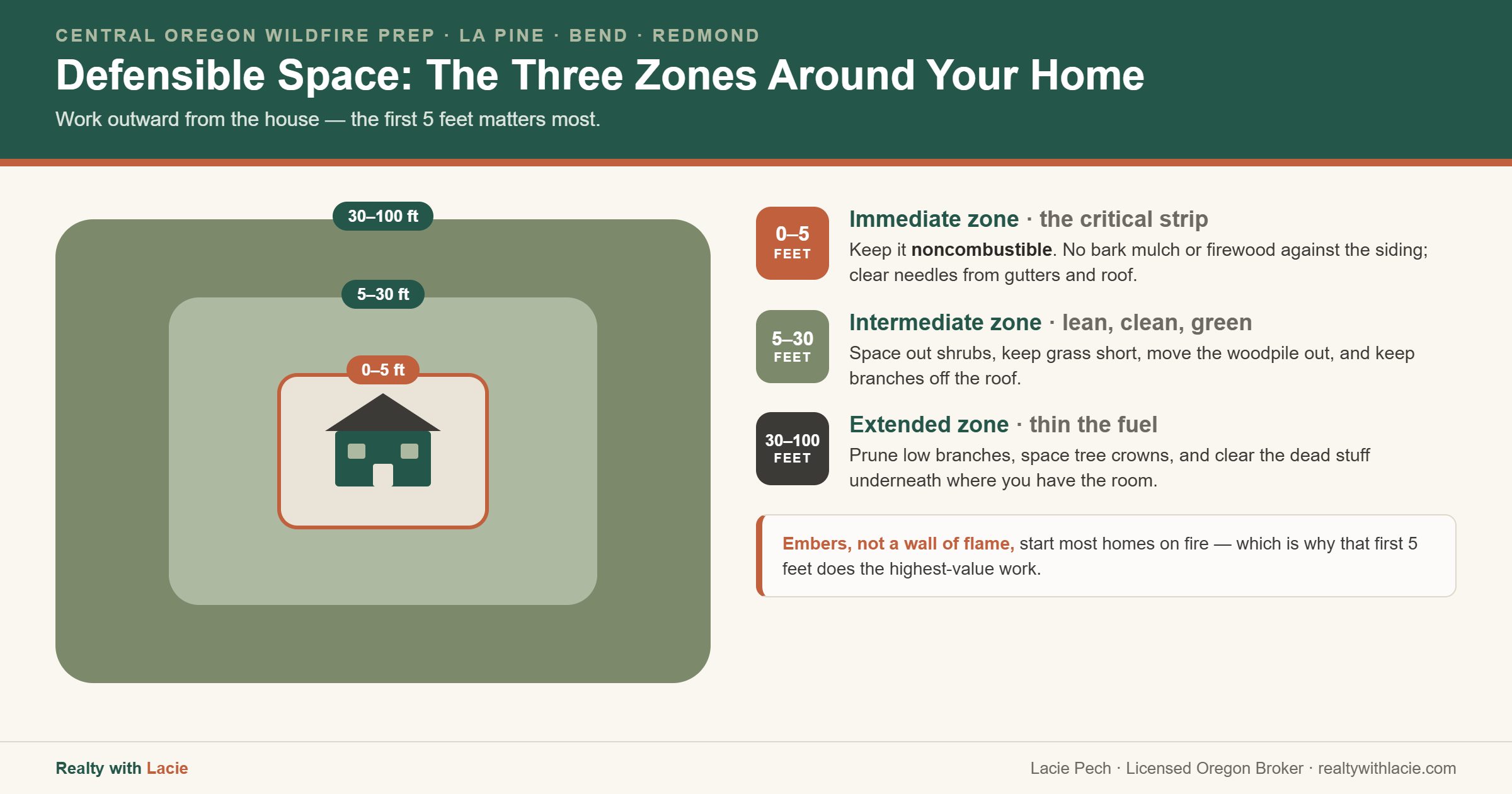
Defensible space is the cleared, hardened buffer around your home. It’s usually described in zones: the first 5 feet, out to about 30 feet, and out to roughly 100 feet where you have the room.

Houses in a wildfire usually catch from blowing embers landing in a weak spot, not a wall of flame. That’s why the first 5 feet and the roof and gutters matter more than people expect.

Oregon repealed its statewide wildfire map in 2025, so the old mandatory rules for existing homes are gone. Defensible space is still smart, still cheap to start, and still something insurers pay attention to. The first 5 feet is mostly free and it’s where I’d start.

What is defensible space, really?

It’s the space between your house and everything that can burn near it. The goal isn’t a moonscape. It’s to break up the fuel so a fire slows down, drops out of the treetops, and gives crews a place to actually defend the home.

Most guidance breaks it into three zones working outward from the house.

The first zone

0 to 5 feet

The strip right against the house. This is the most important and the most ignored. Keep it as noncombustible as you can: no bark mulch against the foundation, no firewood stacked on the siding, gutters and roof valleys clear of pine needles.

The middle zone

5 to 30 feet

Lean, clean, and green. Space out shrubs, keep the grass short and watered where you can, move the woodpile out here and away from the wall, and don’t let tree branches hang over the roof.

The outer zone

30 to 100 feet

Thin it out and break up the ladder. Prune low branches, leave space between tree crowns, and clear the dead stuff underneath. On a small lot you may not have this zone. On La Pine or Tumalo acreage, this is where a lot of the real work lives.

Does the La Pine, Bend, or Redmond part actually matter?

It does, because the fuel is different and so is the job.

La Pine and the deep-forest lots are mostly ponderosa and lodgepole, and the risk is standing trees, heavy needle cast, and a lot of ground fuel. Pine needles in the gutters and on the roof are a real problem here, and the outer thinning zone matters because there’s actual forest to thin.

Bend spreads across a wide range, from close-in lots to the west side and the neighborhoods that push right up against the trees. The homes backing to the forest edge carry more of the same work La Pine does, while a central Bend lot is mostly about the roof, the gutters, and the first 5 feet.

Sisters sits right up against the Cascade forest, so it carries the deep-timber version of this, closer to the La Pine job than the Redmond one. The Akawa Butte Fire this summer, out in the country northeast of town, was a reminder of how much fuel there is once you leave the city core.

Redmond is the one people underestimate, and this summer showed why. It’s juniper, sage, and grass more than deep timber, and that fuel dries out and moves fast in wind. The Coyner Fire ran through exactly that. You don’t need to be in the woods to have a defensible-space job.

What actually catches a house on fire?

This is the part my husband points out on almost every walkthrough. Most homes that burn in a wildfire don’t get taken by a wall of flame rolling over them. They catch from embers, sometimes blown in from well over a mile away, landing somewhere they can smolder and take hold.

So the house itself matters as much as the yard. The usual weak spots are the roof and gutters full of needles, vents that let embers into the attic or crawlspace, the first few feet around the foundation, and anything combustible tucked under a deck. Hardening those is often small, unglamorous stuff: cleaning the roof and gutters, screening or upgrading vents, keeping the 5-foot zone clean, and not storing the firewood and the plastic bins against the siding.

None of that requires tearing the house apart. A lot of it is a Saturday and a ladder.

Wait, didn’t Oregon get rid of the wildfire map?

Yes, and this trips people up, so here’s the honest version. In 2025 Oregon repealed its statewide wildfire hazard map through Senate Bill 83. That map had assigned properties to risk zones and carried mandatory defensible space and building standards, and it was unpopular enough that the Legislature undid it.

What that means in practice: the mandatory statewide requirements tied to that map for existing homes went away. Wildfire mitigation building standards now apply mainly to new construction, and the state is putting together a model code that local governments can choose to adopt. Your own city or county can still have rules, so it’s worth checking locally rather than assuming there are none.

Here’s the thing though. The map going away didn’t change how fire behaves, and it didn’t change what insurers care about. Defensible space is still recommended, and the state has specifically pointed to defensible space and home hardening as steps that can reduce risk. Gone is the mandate, not the reason.

What does this mean if you’re buying or selling here?

If you’re buying, especially in La Pine or on the forest edge, look at the defensible space and the roof and vents the same way you’d look at the furnace. Ask what’s been done. Factor in the work if it hasn’t. And start the home insurance conversation early, because in higher-risk areas getting a policy can take longer and cost more than buyers expect. That’s a question for your insurance agent, not a surprise for closing week.

If you’re selling, a clean 5-foot zone, clear gutters, and a tidy outer yard genuinely help. It reads as a cared-for home, and it’s one less thing a buyer’s inspector or insurer flags. Deschutes County’s FireFree program does free yard debris drop-off events, usually in spring, at sites around Bend, Redmond, Sisters, La Pine, and beyond. Dates move each year, so check firefree.org for the current schedule.

The honest stuff

Defensible space isn’t a force field. In a bad wind-driven fire, embers travel and homes with good clearance still sometimes don’t make it. Anyone who promises you a guarantee is selling something.

But it meaningfully improves the odds, it gives firefighters a fighting chance to defend your place, and it’s the part of wildfire risk you can actually do something about. If all you ever do is the first 5 feet and the roof, you’ve done the highest-value work there is. Start there.

Central Oregon defensible space FAQ

What is defensible space?

It’s the buffer between your home and the grass, brush, and trees around it, built to slow a fire down and give crews a safer place to work. It’s usually described in zones: the first 5 feet, out to about 30 feet, and out to roughly 100 feet where the property allows.

How much defensible space do I need in Central Oregon?

The common guidance is to work outward in zones to about 100 feet where you have the room. The first 5 feet matters most. On a smaller Redmond or Bend lot you work with what you’ve got. On La Pine or Tumalo acreage, the outer zone is where much of the work is.

Is defensible space required by law in Oregon right now?

In 2025 Oregon repealed its statewide wildfire hazard map through Senate Bill 83, which removed the mandatory defensible space and home-hardening rules that had been tied to that map for existing homes. Mitigation building standards now apply mainly to new construction, and a model code is being developed for local governments to adopt if they choose. Local rules can still apply, so check with your city or county. Even without a statewide mandate, defensible space is still strongly recommended.

Does defensible space affect home insurance?

It can. Insurers weigh wildfire risk when they decide whether to write a policy and what to charge, and defensible space and home hardening are among the steps the state has pointed to for reducing risk. It’s not a guaranteed discount. For your specific situation, talk to your insurance agent, since that’s their lane and not mine.

What’s the cheapest first step?

The first 5 feet, and it’s mostly free. Move firewood off the siding, clear pine needles from gutters and the roof, pull bark mulch back from the foundation, and trim branches touching the house. No contractor required, and it targets exactly where blowing embers tend to start a fire.

Where can I dump yard debris for free in Deschutes County?

Deschutes County’s FireFree program runs free yard debris drop-off events, usually in the spring, at sites including Bend, Redmond, Sisters, La Pine, Sunriver, and Madras. Dates change each year, so check firefree.org or the Deschutes County site for the current schedule.

If you’re looking at a place in La Pine, Bend, or Redmond and you’re not sure how big the defensible-space job really is, I’m glad to walk it with you. Between thirty years here and a contractor in the family, we can usually tell pretty quickly what’s a Saturday and what’s a real project. No pressure, just an honest read. 🌲

Market Updates August 6, 2026

Bend and Redmond housing market, summer 2026: what the numbers actually mean for you

By Lacie Pech, Realty with Lacie. Licensed Oregon real estate broker, born and raised in Central Oregon.

Every month a new set of Central Oregon market stats comes out, and every month somebody sends me a screenshot of one number with a worried text attached. Usually it’s the median sale price, and usually the number is missing all the context that would actually tell you what’s going on.

So here’s the honest version for the Bend and Redmond real estate market this summer. Not the scary headline, not the everything-is-amazing pitch. Just what the numbers say and what they mean if you’re the one buying or selling.

Quick note before the numbers: I’m a broker, not your lender or your accountant. This is the market, not advice about your specific situation. For that, let’s actually talk.

The short version

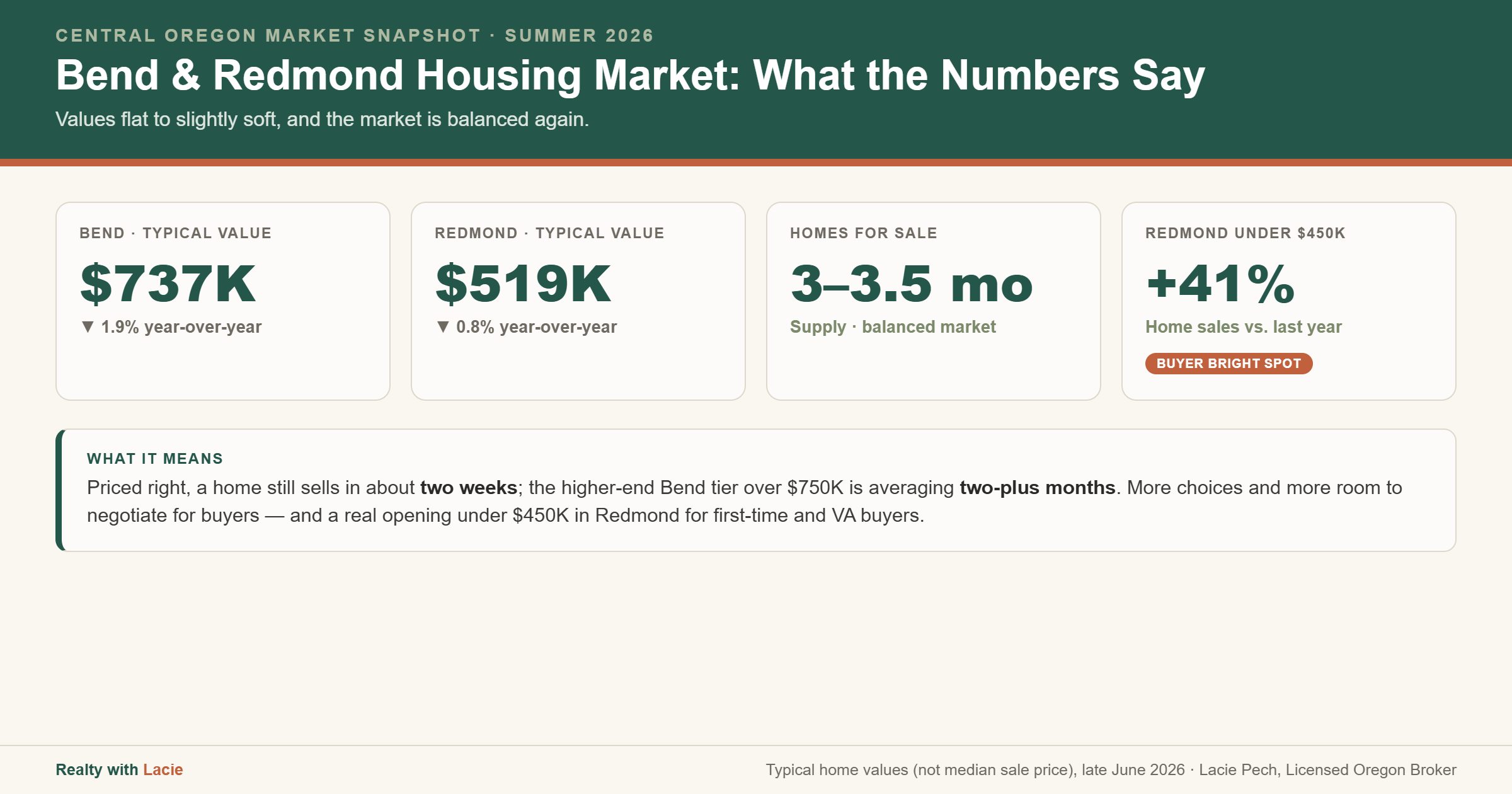
  • Values are close to flat and a touch soft year over year. Bend’s typical home value was around $737,000 as of late June, down about 1.9%. Redmond was around $519,000, down about 0.8%.
  • The market is more balanced than it’s been in years, sitting near a three to three-and-a-half month supply of homes.
  • Speed is all about price. Priced right, a home still sells in a couple of weeks. Priced high, it sits.
  • The bright spot for buyers is Redmond under $450,000, where sales were up about 41% over last year.

So did prices go up or down this summer?

Both, depending on which number you look at, and this is the part that trips people up.

There are two very different ways to measure a market. The first is the typical value of a home, which is basically an estimate across all the houses in town whether they sold or not. As of late June, that number sat around $737,000 in Bend and around $519,000 in Redmond, both down slightly from a year ago. That’s the flat, slightly soft story, and it’s the more stable one.

The second is the median sale price, which is only the homes that actually closed that month. That one bounces around a lot. If a bunch of higher-end Bend homes happen to close in May, the median jumps. If more starter homes close, it drops. It’s not that prices swung 15% in thirty days, it’s that a different set of houses sold. That’s the plumbing behind the number, and once you see it you stop panicking at every monthly report.

How fast are homes actually selling in Bend and Redmond?

Faster than the doom talk suggests, if they’re priced correctly. Well-priced Bend homes have been going to pending in roughly two to three weeks. Redmond runs a little longer, closer to three to four weeks on average.

But that average hides a split. A home priced where the market actually is can still sell in under two weeks with multiple people interested. A home priced on hope sits, and the higher-end tier over $750,000 has been averaging more like two-plus months. Same town, same week, totally different outcome, and the only variable that changed was the list price.

Both Bend and Redmond are sitting near a three to three-and-a-half month supply of homes. That’s a lot healthier than the one-month, everybody-fighting-over-everything market we had a few years ago. More choices for buyers, less automatic leverage for sellers.

What this means if you’re buying in Central Oregon

You have more room than buyers did in 2022, and I mean that literally. More homes to choose from, more time to make a decision, and more willingness from sellers to negotiate on price, repairs, or closing costs.

The standout right now is Redmond under $450,000. Sales in that range were up about 41% over last year, which tells me first-time and VA buyers are finding real options there. If that’s you, this is a market worth being in, not sitting out. Just know the top of the Bend market is a different animal, where cash made up roughly 41% of purchases, so competition still shows up on the higher-priced and turnkey homes.

My husband’s a contractor, so here’s the part I always add: the sticker price is only half the cost of a house. On the older stock, especially out toward La Pine and Prineville, budget for the well, the septic, the roof, and the heat source, not just the payment. I’d rather you know that going in than find it out after.

What this means if you’re selling

The market rewards accurate pricing right now and punishes optimistic pricing, quietly but expensively. In Redmond, sellers have been getting around 96% to 97% of their original list price so far this year, which means the overpriced ones are cutting later and netting less.

The pattern I keep seeing: a home that’s priced right sells in the first two or three weeks near ask. A home priced 5% high sits, goes stale, and eventually sells for less than it would have if it had launched at the right number. Buyers can tell when something’s been sitting, and a stale listing negotiates from weakness.

Erin and I list together, and pricing strategy is the first real conversation we have with every seller, before photos, before anything. Get that part right and the rest gets a lot easier.

The honest stuff about that median price headline

Here’s the thing nobody wants to say out loud. The single median number you see in a headline is close to useless for your house.

It lumps a downtown Bend home and a La Pine manufactured home and a Redmond starter into one figure, so it doesn’t describe your neighborhood, your price band, or your street. A median can rise in a month when your specific type of home actually softened, and vice versa. It’s a temperature for the whole region, not a diagnosis for your address.

If you want to know what’s happening to a home like yours, you need the comparable sales for your town, your price range, and your last ninety days. That’s a fifteen-minute conversation, and it’s a lot more useful than any one number in an article, including this one.

Central Oregon market FAQ

Are home prices in Bend, Oregon going down in 2026?

As of late June 2026, the typical Bend home value was about $737,000, down roughly 1.9% from a year earlier, and Redmond was about $519,000, down about 0.8%. So values are close to flat and slightly soft year over year, not crashing. The monthly median sale price moves around a lot more than that because it depends on which homes happened to close that month.

How long does it take to sell a house in Bend or Redmond right now?

It depends almost entirely on price. Well-priced homes in Bend have been going to pending in roughly two to three weeks, and Redmond a little longer. Homes priced above the market can sit for two months or more. Both markets are near a three to three-and-a-half month supply, which is close to balanced.

Is now a good time to buy a home in Central Oregon?

There’s more inventory and more room to negotiate than there was a couple of years ago, especially under $450,000 in Redmond, where sales in that range were up about 41% over last year. Whether it’s the right time for you depends on your own numbers, your timeline, and your loan, not on a market headline.

What does months of supply mean?

It’s how long it would take to sell every home currently for sale if no new ones came on, at the current pace of sales. Under about three months usually favors sellers, and five to six months is considered balanced. Bend and Redmond are near three to three-and-a-half months right now.

Are sellers still getting over asking price in Central Oregon?

Mostly not anymore. In Redmond, sellers have been receiving around 96% to 97% of their original list price so far in 2026. Priced right, a home can still sell fast and near ask. Priced high, it tends to sit and then sell for less after a reduction.

If you’re trying to figure out what this market means for your actual house or your actual budget, that’s the fun part for me. No pressure, just real info. Tell me your town and your price range and I’ll walk you through what’s really happening for homes like yours, including the honest stuff. 🏔️

I’ve got you.
Lacie


Market figures reflect the most recent Central Oregon data available as of early August 2026, from public sources including Zillow home value data (as of June 30, 2026) and reported Bend and Redmond closed-sale statistics for 2026. Real estate figures shift monthly and vary by neighborhood and price range. This article is general market information, not legal, lending, or tax advice.

Neighborhoods & Community July 31, 2026

Things to Do in Central Oregon Before School Starts: A Local’s End-of-Summer List for Bend, Redmond, and Sisters

By Lacie Pech, Realty with Lacie. Licensed Oregon real estate broker, born and raised in Central Oregon.

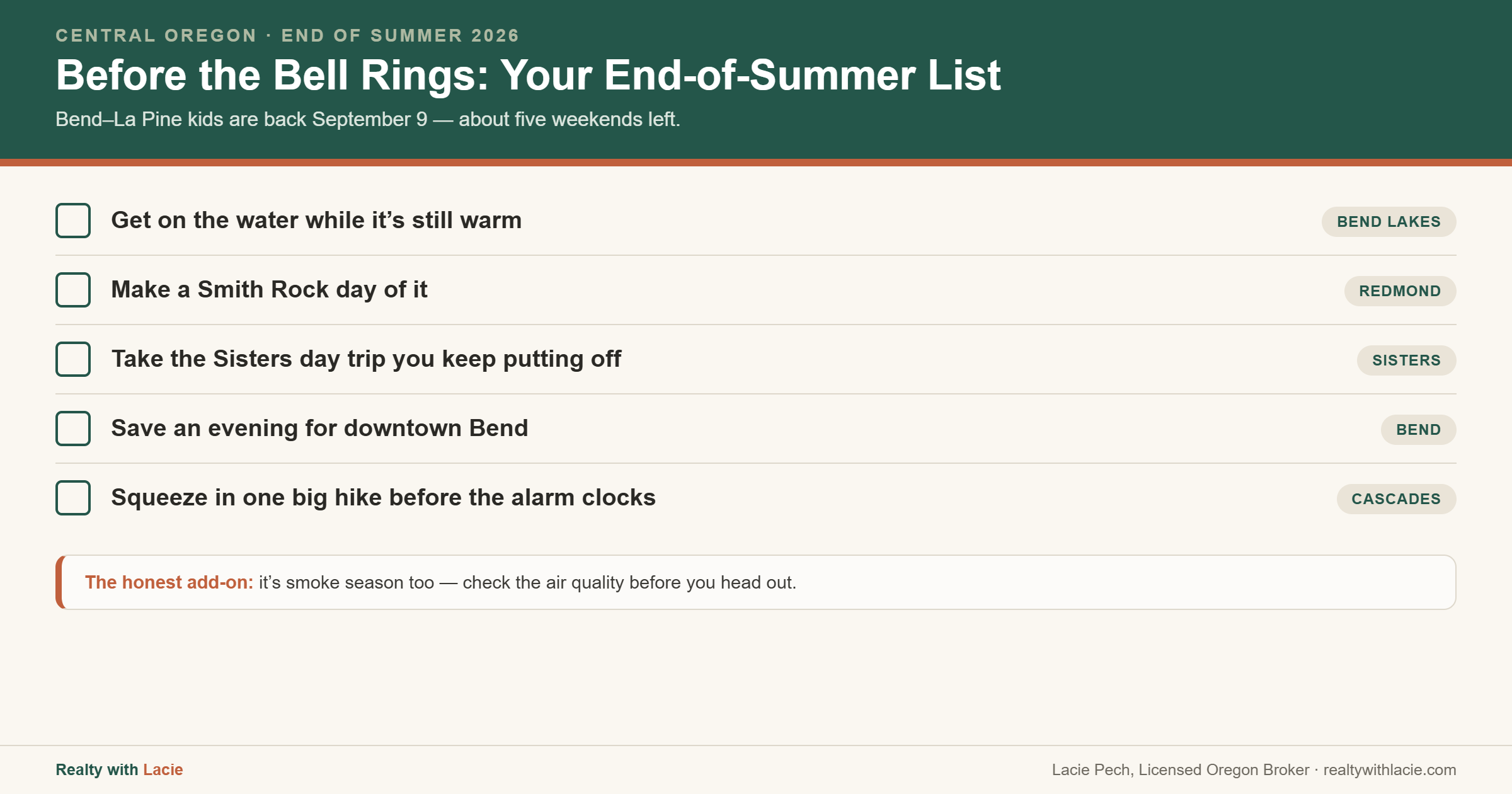
Okay, here’s the thing about this stretch of summer. The Deschutes County Fair is going right now in Redmond, wrapping up this weekend, the mornings are getting that little bite to them, and school is closer than any of us want to admit. Bend-La Pine kids head back on September 9 this year, with everyone in class by the 11th, so we’ve got about five real weeks left.

I’ll be honest, this one hits a little different for me this year. My oldest starts kindergarten in September, so this is my first real end-of-summer-into-school-year as a parent, and I am feeling the countdown in a way I never used to. Suddenly the float trips and lake days feel less like a to-do list and more like a thing I do not want to run out of time on.

So I plan showings around my own kid’s summer schedule, and I know the feeling of looking at the calendar and going, wait, did we actually do the summer stuff yet? This is my honest, locals-first list of what’s worth doing before the backpacks come out, across Bend, Redmond, and Sisters. Some of it you already know. Some of it I’m betting you keep meaning to do and haven’t.

The short version: Float the Deschutes, get to a Cascade lake or two, do a Sisters day trip, catch a free Thursday night concert in Drake Park, and pick one big hike before the alarm clocks come back. Keep an air quality app handy, because this is smoke season. Everything below is the longer, more useful version.

Get on the water while it is still warm (Bend)

If you do one thing before school starts, float the Deschutes. Duh-SHOOTS, for anyone still working on it. The classic run is Riverbend Park down through the Old Mill to Drake Park, and the Ride the River shuttle means you are not stranded at the bottom with a wet tube and a long walk. It is the most Bend thing you can do, and it is basically free.

When you want actual swimming instead of floating, head up the Cascade Lakes Highway. Elk Lake is my easy pick for families: a lodge, paddle rentals, and water that is not going to give anyone hypothermia by August. Sparks Lake is the one for calm-water paddling and the kind of view that makes people move here. Both are close enough to be a half-day, back in time for dinner.

Make a Redmond and Smith Rock day of it

Redmond gets treated like the place you drive through on the way to somewhere, and that is a mistake. Smith Rock State Park in nearby Terrebonne is worth the trip on its own. The Misery Ridge trail earns its name, so save it for a cooler morning and bring more water than you think you need, but the little River Trail along the Crooked River is flat and doable with younger kids.

If your family is more county-fair-and-corn-dogs than switchback-and-sunscreen, the Deschutes County Fair and Rodeo runs at the Redmond expo center from the end of July through the first weekend of August. It is the biggest annual event in Central Oregon, and it is exactly as loud, greasy, and fun as it should be, so if you are reading this early enough, go catch the tail end of it.

Take the Sisters day trip you keep putting off

Sisters is a 25-minute drive and a completely different feel from Bend, and that is the whole point. Walk the downtown, hit the fly shop or the bakery, then get out into the actual Sisters Country. Suttle Lake has a swim area, a lodge, and a flat loop trail around the water that is one of the most underrated family outings out here. The Peterson Ridge trails just south of town are a good bike-and-hike option that does not require a full expedition.

Save the evenings for downtown Bend

Late summer evenings here are the reason people put up with February. On Thursdays in early August, Munch and Music takes over Drake Park with a free concert, food carts, and roughly every family in town on a blanket. Go early, bring a blanket, let the kids run.

The Bend Farmers Market runs downtown on Wednesdays if you want peaches and a low-key afternoon. And when you just want a win with no planning, drive up Pilot Butte at sunset. It is a cinder cone in the middle of town with a 360-degree view of the Cascades, and it takes ten minutes. I still recommend it to people who have lived here for years and somehow never go.

The honest stuff: August is smoke season

I am not going to sell you a postcard. August in Central Oregon can mean wildfire smoke, and the air quality can flip from perfect to stay-inside in a day. Every local I know checks an air quality app before committing to a big outdoor plan this time of year. That is not a reason to skip summer, it is a reason to have a backup.

My backup list: the High Desert Museum south of Bend is genuinely good and eats an entire afternoon, indoors and out. The aquatic centers in Bend and Redmond are the move on a hot or hazy day. And there is zero shame in a matinee. Plan the lakes and the big hikes for the clear days and keep these in your back pocket for the rest.

Pick one big hike before the alarm clocks come back

If you want the summer to feel finished, do one hike that actually takes some effort. Tumalo Falls is the low-lift option, a short walk to a big waterfall right outside Bend. Green Lakes off the Cascade Lakes Highway is the classic bigger day, and the payoff is ridiculous. Go on a clear-air morning, start early to get parking, and let that be the trip everyone remembers when they are complaining about homework in October.

When does school actually start? (Central Oregon, 2026)

For Bend-La Pine Schools, the 2026-27 year starts staggered: most grades on Wednesday, September 9, grades 7-8 and 10-12 on Thursday, September 10, and full attendance for everyone by Friday, September 11. Redmond and Sisters families should double check their own district calendars, since start dates shift by a day or two, but early September is the window across the region. Translation: you have until Labor Day weekend and a little past it to get the good stuff in.

Central Oregon end-of-summer FAQ

When does school start in Bend, Oregon in 2026?

Bend-La Pine Schools start the 2026-27 year on a staggered schedule. Most grades begin Wednesday, September 9, 2026, grades 7-8 and 10-12 start September 10, and everyone is in class by Friday, September 11.

What is there to do with kids in Bend in August?

Float the Deschutes from Riverbend Park to Drake Park, swim at Cascade lakes like Elk Lake and Sparks Lake, catch a free Munch and Music concert in Drake Park on Thursday evenings, hit the Bend Farmers Market on Wednesdays, or walk up Pilot Butte at sunset. The High Desert Museum is the go-to on a hot or smoky afternoon.

Is August smoky in Central Oregon?

It can be. Wildfire smoke is a real part of late summer here, and locals check an air quality app before planning an outdoor day. When the air is bad, lean on indoor backups like the High Desert Museum or the pool and save the big hikes for a clear day.

What are free things to do before school starts?

Plenty. Floating or swimming the Deschutes, hiking Pilot Butte or Tumalo Falls, browsing the Bend Farmers Market, and the free Thursday Munch and Music concerts in Drake Park all cost nothing but parking and sunscreen.

What is the best lake near Bend for families?

Elk Lake is the easy pick: a lodge, paddle rentals, and warmer, calmer edges right off the Cascade Lakes Highway. Sparks Lake is better for paddling and views, and Suttle Lake near Sisters makes a great day trip.

That is my list, and this year I am checking it off right alongside you, one kindergartner and a very short countdown in tow. If your summer here has you quietly wondering what it would be like to do this every year instead of on vacation, that is a normal thought to have in August, and I am happy to talk through what living in Bend, Redmond, or Sisters actually looks like. No pressure, just real info. I grew up here, I will tell you the honest stuff, and I am around whenever you want to chat. 🏔️

Reading this after Labor Day? The fall version is up: pumpkin patches, festivals, and golden larches in Central Oregon.

Now go float the river before you can’t.